


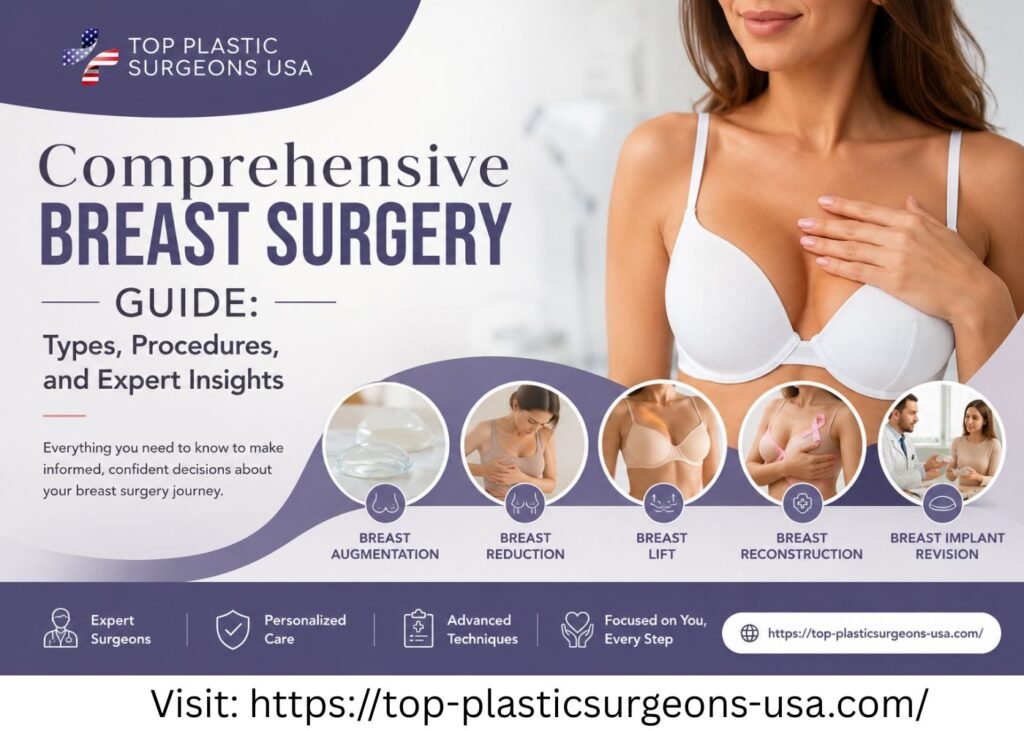
Breast surgery is one of the most personal medical decisions a person can make. Whether someone is looking to change how their body looks, ease physical discomfort, or rebuild after illness, breast surgery covers a wide range of procedures designed to help people feel better in their own skin. In the United States alone, hundreds or thousands of breast procedures are performed every year, making it one of the most commonly requested areas of plastic surgery.
This guide walks you through everything you need to know, from the different types of breast surgery to what recovery actually looks like, how much it costs, and how to find the right surgeon for your needs.
What Is Breast Surgery?
Breast surgery is any procedure that changes the size, shape, position, or structure of the breasts. These procedures fall into two broad groups: cosmetic and medical.
COSMETIC BREAST SURGERY
- Done entirely by personal choice.
- The goal is to improve appearance, symmetry, or size.
- Driven by personal confidence and body satisfaction goals.
- Generally not covered by insurance.
MEDICAL BREAST SURGERY
- Done out of health necessity.
- Includes removal of breast tissue to treat or prevent breast cancer.
- Includes rebuilding the breast after entire breast removal.
- May be partially or fully covered by insurance.
Some procedures, like breast reduction, sit in both categories. They solve a real physical problem and improve how a person looks and feels.
Understanding which type applies to your situation is the first step to making the right decision.
Cosmetic vs Medical Breast Surgery
| Category | Purpose | Insurance Coverage | Examples |
| Cosmetic | Improve appearance or size | Usually not covered | Augmentation, Lift |
| Medical | Treat a health condition | Often covered | Reconstruction, medically needed |
| Both | Health + appearance improvement | Sometimes partially covered | Breast Reduction (documented symptoms) |
Main Types of Breast Surgery
There is no single “breast surgery.” The term covers several very different procedures. Here is a clear breakdown of each one.
Breast Augmentation
Breast augmentation is the process of increasing breast size using implants or, in some cases, fat moved from another part of the body. It is one of the most commonly performed cosmetic surgeries in the United States.
WHY PEOPLE CHOOSE IT:
- Breasts feel naturally small or uneven.
- Breasts changed after pregnancy, breastfeeding, or significant weight loss.
- Seeking greater confidence in clothing and appearance.
- Wanting to restore breast volume lost with age.
WHO IT IS GENERALLY SUITABLE FOR:
- Adults 18 or older (22+ for silicone implants, per FDA guidelines).
- People who are in good overall physical health.
- Non-smokers, or those willing to quit before and after surgery.
- People who are not currently pregnant or breastfeeding.
- Those with realistic, personal goals (not external pressure).
Breast Reduction
Breast reduction is the surgical removal of excess breast tissue, skin, and fat to make the breasts smaller and lighter. While it does improve appearance, many people pursue this surgery because of real physical problems caused by very large breasts.
PHYSICAL PROBLEMS THAT OFTEN LEAD TO REDUCTION:
- Constant neck, shoulder, and upper back pain.
- Bra straps that dig deeply into the shoulders.
- Skin rashes, irritation, or repeated infections under the breasts.
- Difficulty in exercising or staying physically active.
- Trouble finding clothes that fit properly.
- Numbness or tingling in the arms is caused by nerve pressure.
- Poor posture developed from carrying the extra weight.
Because of these physical effects, breast reduction is sometimes covered by health insurance when a doctor confirms it is medically necessary. A plastic surgeon can help you understand whether you qualify or not.
Breast Lift
A breast lift lifts and shapes breasts that have started to sag or droop. It doesn’t make a big difference in the size of the breasts. Instead, it moves the breast tissue around and takes away extra skin to make the breasts look firmer and younger on the chest.
THINGS THAT OFTEN CAUSE SAGGING:
- Pregnancy and nursing.
- A lot of weight loss or weight gain.
- Aging naturally and losing firmness in the skin.
- Over time, gravity is especially problematic for women with bigger breasts.
When someone wants both a better shape and more volume, they may get both a breast lift and an augmentation. A qualified surgeon can help you figure out which combination is best for you during a consultation.
Breast Reconstruction
Breast reconstruction rebuilds one or both breasts after they have been removed or damaged. This most often follows a breast removal surgery to treat or prevent breast cancer. It can also be needed after a serious injury or accident.
RECONSTRUCTION METHODS:
- Implant-based reconstruction: Using silicone or saline implants to rebuild the breast shape.
- Tissue-based reconstruction: Using tissue moved from another part of the body (such as the stomach or back).
- Combined approach: Using both tissue and implants together for the best result.
TIMING OPTIONS:
- Immediate reconstruction: Done at the same time as the Breast removal surgery.
- Delayed reconstruction: Done weeks, months, or even years after the Breast removal surgery.
- Staged reconstruction: A multi-step process done over several appointments.
There is no right or wrong timing. What matters most is that the patient feels fully supported, informed, and ready before moving forward.
Breast Implant Revision
Breast implant revision is a second surgery to change, replace, or take out implants that were put in during a previous surgery. A lot of people don’t know that it’s more common than they think.
REASONS THAT PEOPLE OFTEN HAVE REVISION SURGERY:
- The implant has moved or shifted from its original place.
- The implant’s outer shell has either broken or lost air.
- The implant has caused hard scar tissue to form around it, which makes the breast feel stiff.
- The patient wants a different type, size, or shape of implant.
- Changes to the body that happen as you get older, gain or lose weight, or become pregnant.
- Wanting to have the implants taken out completely (explantation)
Anyone thinking about getting implants should know that they might need revision surgery at some point in the future. This is just a part of what it’s like to have implants for a long time.
Comparison between All Five Breast Surgery Types
| Procedure | Main Goal | Changes Size? | Typical Candidates |
| Breast Augmentation | Increase size and fullness | Yes, larger | Adults wanting more volume |
| Breast Reduction | Decrease size and weight | Yes, smaller | Those with pain or discomfort from large |
| breasts | |||
| Breast Lift | Raise and reshape | Minimal | Those with sagging from age, pregnancy, or |
| weight loss | |||
| Breast Reconstruction | Rebuild after removal | Varies | Post-mastectomy patients or injury survivors |
| Implant Revision | Fix, replace, or remove | Varies | Anyone with existing implants needing changes |
Breast Surgery Procedures Explained: Step by Step
Regardless of which type of breast surgery you are having, the overall process follows a similar path. Here is what to expect from first to last.
STEP 1: INITIAL CONSULTATION
- Meet with a board-certified plastic surgeon.
- Discuss your goals, concerns, and health history.
- Surgeon performs a physical examination.
- You review options together and ask questions about the breast surgery.
- 3D imaging may be used to preview possible results.
- Never feel rushed during this step. A good surgeon takes the time you need.
STEP 2: PRE-SURGERY PREPARATION
- Complete any required lab work or blood tests.
- Get a breast X-ray if recommended based on age or history.
- Stop certain medications that increase bleeding risk.
- Quit smoking at least four to six weeks before surgery.
- Arrange for a trusted adult to drive you home and stay with you the first night.
- Avoid eating or drinking after midnight before your surgery date.
STEP 3: ANESTHESIA
- General anesthesia: You are completely asleep. Used for most breast procedures.
- Local anesthesia with sedation: You are relaxed and comfortable but not fully unconscious. Used for some minor procedures.
- An anesthesiologist or certified nurse anesthetist monitors you throughout surgery.
STEP 4: THE SURGERY ITSELF
For augmentation:
- Small cuts are made (under the breast fold, around the nipple, or in the armpit).
- The implant is placed either under or above the chest muscle.
- Cuts are closed with stitches.
For a breast lift:
- Extra skin is removed.
- Breast tissue is reshaped and repositioned higher on the chest.
- The nipple is repositioned if needed.
- Cuts are closed in a way designed to minimize visible scarring.
For breast reduction:
- Excess tissue, fat, and skin are removed.
- The breast is reshaped to a smaller, more comfortable size.
- The nipple may be repositioned.
For reconstruction:
- Either implants, body tissue, or both are used to rebuild the breast shape
- Multiple stages may be required depending on the chosen method.
STEP 5: IMMEDIATE RECOVERY
- You are moved to a monitored recovery area.
- Nurses, check your vital signs as anesthesia wears off.
- Most patients go home the same day.
- Some complex procedures require one night in the facility.
STEP 6: GOING HOME
- A responsible adult must drive you and stay with you the first night.
- You will have a surgical bra or compression wrap in place.
- You receive pain medication and aftercare instructions.
- A follow-up appointment is scheduled within one to two weeks.
Types of Breast Implants
For anyone considering augmentation or reconstruction with implants, understanding your options makes the decision much easier.
SILICONE vs SALINE
| Feature | Silicone Implants | Saline Implants |
| Filling material | Thick silicone gel | Sterile saltwater |
| Feel | Softer, closer to natural tissue | Firmer, more noticeable |
| Appearance | Very natural, especially in thin patients | Can look slightly rounder |
| If the shell breaks | Gel tends to stay in place (silent break) | Saline absorbs safely; shape change is |
| immediately obvious | ||
| Monitoring needed | Regular MRI or ultrasound recommended | Visual/physical check is usually enough |
| FDA age minimum | 22 years old | 18 years old |
| Popularity | Most commonly chosen in the U.S. | Less common but still widely available |
IMPLANT SHAPES
Round implants:
- Add fullness throughout the breast, especially at the top.
- Create a rounder, fuller silhouette.
- Cannot rotate out of position (no visual change if they move).
- Most commonly used in the United States.
Shaped (Teardrop) implants:
- Follow the natural slope of the breast.
- More fullness at the bottom, tapered toward the top.
- Look slightly more natural in some body types.
- Require a textured surface to stay in position.
IMPLANT SIZE
- Measured in cubic centimeters (cc).
- A larger cc number means a larger implant.
- The right size depends on your body frame, chest width, existing tissue, and personal goals.
- Surgeons often use physical sizers or 3D imaging during consultation to help you decide.
- Bigger is not always better. The goal is proportion and balance with your overall frame.
SAFETY FACTS ABOUT IMPLANTS:
- All implants sold in the U.S. are FDA-approved and have undergone safety testing
- Implants are not designed to last forever. Average lifespan is 10 to 20 years.
- Regular monitoring is part of responsible long-term implant care
- Your surgeon will advise you on how often to schedule follow-up imaging
Benefits of Breast Surgery
The benefits of breast surgery go beyond just physical appearance. For many people, the changes feel genuinely life-changing.
PHYSICAL BENEFITS:
- Relief from chronic back, neck, and shoulder pain, especially after reduction.
- A more balanced and proportional body shape.
- Improved ability to exercise comfortably and consistently.
- Better-fitting clothing across styles and sizes.
- Restored breast shape and volume after pregnancy, breastfeeding, or weight loss.
- Rebuilt breast appearance after cancer treatment.
EMOTIONAL AND PSYCHOLOGICAL BENEFITS:
- Greater confidence in appearance and personal presentation.
- Improved sense of self-worth and body satisfaction.
- Feeling more comfortable in social situations and relationships.
- A sense of wholeness and restoration, particularly for reconstruction patients.
- Reduced self-consciousness in clothing, swimwear, and intimate settings.
Studies consistently show that when results meet a patient’s realistic expectations, satisfaction rates are very high. Many patients report that the emotional benefits were even greater than the physical improvements they expected.
That said, surgery works best when the decision comes from a personal, well-considered place. Not from pressure, comparison, or the desire to meet someone else’s expectations.
Risks and Potential Complications
Every surgery carries some level of risk. Being fully informed about possible complications is a key part of making a responsible, confident decision.
COMMON RISKS :
- Temporary pain, swelling, and bruising after surgery.
- Changes in nipple or breast sensation (usually temporary, occasionally long-lasting).
- Visible scarring that takes one to two years to fully fade.
- Temporary difficulty moving the arms or upper body.
- Fluid buildup around the surgical area.
LESS COMMON RISKS:
- Infection requiring antibiotics or additional treatment.
- Poor wound healing, particularly in smokers.
- Reaction to anesthesia.
- Asymmetry between the two sides.
- Need for a second procedure to correct an issue.
IMPLANT-SPECIFIC RISKS:
- Implant shifting or moving from its original position.
- Implant shell breaking.
- Hard scar tissue forming around the implant, causing stiffness.
- A very rare immune-related condition called BIA-ALCL (breast implant-associated anaplastic large cell lymphoma), which is not breast cancer but requires monitoring.
HOW TO REDUCE YOUR RISK:
- Choose a board-certified breast surgeon with specific experience in your procedure.
- Have surgery performed in an accredited surgical facility.
- Be completely honest about your health history and medications.
- Follow all pre-surgery preparation instructions.
- Follow all post-surgery aftercare instructions carefully.
- Attend every follow-up appointment days after surgery.
RISK LEVEL OVERVIEW
| Risk Type | How Common | Typically Resolves? |
| Pain and swelling | Very common | Yes, within weeks |
| Bruising | Very common | Yes, within 2 to 4 weeks |
| Sensation changes | Common | Usually, within months |
| Scarring | All patients | Fades but never disappears |
| Infection | Uncommon | With treatment, yes |
| Implant shift | Uncommon | May require revision |
| Implant rupture | Uncommon | Requires replacement |
| Capsular contracture | Uncommon | May require surgery |
| BIA-ALCL | Very rare | Treatable when caught early |
Recovery and Aftercare
Recovery from breast surgery varies by procedure, but here is a general timeline that applies across most types.
RECOVERY TIMELINE
| Time Period | What to Expect |
| Day 1 to 3 | Soreness, fatigue, and swelling. Rest at home. Pain medication used. |
| Days 4 to 7 | Discomfort begins to ease. Light activity around the house is okay. |
| Week 1 to 2 | Follow-up appointment. Most people return to desk work. |
| Week 2 to 4 | Swelling continues to reduce. Bra or compression garment still worn. |
| Week 4 to 6 | Light exercise may resume. Still no heavy lifting or strenuous work. |
| Month 2 to 3 | Most swelling resolved. Shape begins to settle into final position. |
| Month 3 to 6 | Scars continue to fade. Full results become clearer. |
| Month 6 to 12 | Final healing. Scars are significantly lighter. Implants fully settle |
PAIN MANAGEMENT:
- Prescription pain medication is provided for the first few days.
- Most patients transition to over-the-counter pain relief within the first week.
- Cold packs can help reduce swelling (follow your surgeon’s specific instructions).
- Sleeping slightly elevated (head and upper body raised) can ease discomfort early on.
ACTIVITY RESTRICTIONS:
- No driving while taking prescription pain medication.
- No lifting objects heavier than a few pounds for the first two to three weeks.
- No raising arms above shoulder height in the first one to two weeks.
- No strenuous exercise, running, or heavy physical work for four to six weeks.
- No swimming or submerging the incision areas until fully healed (typically four to six weeks).
- Sexual activity should be avoided for at least two weeks.
LONG-TERM CARE FOR IMPLANTS:
- Schedule regular follow-up imaging as recommended by your breast surgeon.
- Report any changes in breast-like feeling, shape, or appearance promptly.
- Maintain a stable weight where possible, as major changes affect results.
- Protect scars from sun exposure during the healing period to prevent darkening.
Cost of Breast Surgery in the U.S.
Breast surgery is a significant financial investment. Here is a clear breakdown of what to expect.
AVERAGE COST RANGES BY PROCEDURE
| Procedure | Estimated Cost Range | Notes |
| Breast Augmentation | $5,000 to $10,000 | Includes surgeon, anesthesia, and facility |
| Breast Lift | $5,000 to $8,500 | Higher if combined with augmentation |
| Breast Reduction | $6,000 to $12,000 | May be covered if medically necessary |
| Breast Reconstruction | $5,000 to $15,000+ | Varies widely based on method and stages |
| Implant Revision | $3,500 to $9,000 | Depends on the reason and complexity |
Note: These are estimates only. Your actual cost will depend on several personal factors.
FACTORS THAT AFFECT TOTAL COST:
- Surgeon’s level of experience and reputation.
- Geographic location (major cities tend to cost more).
- Type of surgical facility (hospital vs private surgical center).
- Type and brand of implant chosen (if applicable).
- Complexity of your anatomy or situation.
- Whether any additional procedures are combined.
INSURANCE COVERAGE:
- Cosmetic procedures: Generally not covered by insurance.
- Breast reduction: May be covered if chronic pain or other physical symptoms are medically documented.
- Breast reconstruction after cancer: Often covered under the Women’s Health and Cancer Rights Act (WHCRA).
- Always verify your specific coverage and get pre-authorization in writing before scheduling surgery.
FINANCING OPTIONS:
- Many plastic surgery practices offer in-house payment plans.
- Third-party medical financing is available (such as CareCredit or Alphaeon Credit).
- Personal loans or health savings accounts (HSA/FSA) can also be used.
How to Choose the Right Plastic Surgeon
The surgeon you choose is the single most important factor in your outcome. Take this decision seriously and do not rush it.
WHAT TO LOOK FOR:
- Board certification from the American Board of Plastic Surgery (ABPS).
- Specific, substantial experience with your type of procedure.
- Operating privileges at an accredited surgical facility.
- Transparent before-and-after photo portfolios of real patients.
- Clear, unhurried communication during your consultation.
- Willingness to answer all of your questions honestly.
QUESTIONS TO ASK DURING YOUR CONSULTATION:
- How many times have you performed this specific procedure?
- Can I see before-and-after photos of patients with a similar body type?
- What results can I realistically expect given my anatomy?
- What are the risks most specific to my situation?
- What does recovery look like for someone with my health history?
- What happens if I am not satisfied with the result?
- Where exactly will surgery take place, and is that facility accredited?
- Who will be with me during the procedure, and who handles my care afterward?
THINGS TO AVOID BEFORE SURGERY:
| Things to avoid | Why It Matters |
| Pressure to decide quickly | Good surgeons respect your timeline |
| Unusually low prices with no explanation | May signal shortcuts in safety or training |
| Dismissive responses to your questions | You deserve thorough, honest answers |
| Cannot show a strong patient photo portfolio | Experience should be demonstrable |
| No verifiable board certification | Training and qualifications matter enormously |
| Operating out of a non-accredited facility | Safety standards in accredited facilities are higher |
| Promises of perfect or guaranteed results | Ethical surgeons set realistic expectations |
Expert Insights and Tips
Based on what experienced plastic surgeons consistently observe across their practices, here are the most valuable insights for anyone considering breast surgery.
COMMON MISTAKES PATIENTS MAKE:
- Choosing a procedure based on someone else’s result rather than their own body type and proportions.
- Picking an implant size that looks great in photos but does not suit their frame.
- Going too large and later needing revision surgery to reduce size.
- Rushing the decision after only one consultation.
- Choosing a surgeon based on price rather than qualifications and experience.
- Returning to normal activity too soon, which can affect healing and final results.
- Expecting surgery to fix emotional issues or relationship problems.
TIPS FOR GETTING THE BEST OUTCOME:
- Consult with at least two board-certified surgeons before deciding.
- Bring reference photos to your consultation, but use them as communication tools, not exact targets.
- Be completely honest with your surgeon about your health, medications, and lifestyle.
- Follow every single pre-surgery and post-surgery instruction.
- Be patient with the healing process. Final results take months to fully appear.
- Report anything unusual to your surgeon promptly rather than waiting and hoping it resolves.
SETTING REALISTIC EXPECTATIONS:
- Surgery improves appearance but does not create perfection.
- Scars are permanent, though they fade significantly.
- Results continue to change subtly as your body ages.
- Implants are not permanent devices and will likely need attention in the future.
- The goal is the best version of you, not a copy of someone else.
Who Is a Good Candidate for Breast Surgery?
GENERAL ELIGIBILITY CHECKLIST
| Factor | What Good Candidates Typically Have |
| Age | 18+ for most procedures; 22+ for silicone implants |
| Overall health | Stable health with no untreated serious conditions |
| Weight | At or near a healthy, stable weight |
| Smoking | Non-smoker, or committed to quitting before and after surgery |
| Motivation | Personal goals, not external pressure |
| Mental readiness | Realistic expectations and emotional stability |
| Breastfeeding | Not currently pregnant or breastfeeding |
| Breast development | Fully developed breasts (important for younger patients) |
HEALTH CONDITIONS THAT MAY REQUIRE EXTRA EVALUATION:
- Heart conditions or circulation problems.
- Diabetes (affects healing).
- Immune system diseases.
- Bleeding or clotting disorders.
- A history of raised scar.
- Active smoking.
- Obesity (increases surgical risk).
If you have any of these, it does not automatically disqualify you. It simply means your surgeon may request clearance from your primary doctor or a specialist before proceeding.
Frequently Asked Questions
How long does breast surgery last?
The results of a breast lift or reduction can last for 10 years or more, but the body will still change over time due to aging, weight changes, and gravity. Implants don’t last forever; they usually need to be replaced every 10 to 20 years. Results from reconstruction usually last a long time, but touch-up procedures are sometimes done.
Is breast surgery safe?
Most people think that breast surgery is safe when it is done by a board-certified plastic surgeon in a surgical facility that has been approved. There is always some risk involved with surgery, and your surgeon will talk about those risks that are specific to your case during your consultation. If you choose a qualified, experienced surgeon and follow all of their instructions before and after surgery, your risk of complications goes down a lot.
Can breast implants be permanent?
Implants are not meant to last forever. They are medical devices that last a long time, usually 10 to 20 years, but they may need to be replaced or taken out at some point. Some people are able to keep their original implants for a long time without any problems. It is best to check the condition of an implant over time with regular imaging.
When can I return to work after breast surgery?
Most people return to desk work or light office duties within one to two weeks. Those with physically demanding jobs involving heavy lifting or strenuous activity usually need four to six weeks off. Your surgeon will give you personalized guidance based on your specific procedure and recovery progress.
Will breast surgery leave scars?
Yes. All breast surgery involves cuts, and cuts leave scars. Skilled surgeons carefully place incisions in the least visible locations, such as under the breast fold, around the lower edge of the nipple, or in the armpit. Scars typically fade from pink or red to a lighter, flatter line over 12 to 24 months. They do not disappear entirely, but most become very difficult to notice with time.
Does breast surgery affect breastfeeding?
It depends on the specific procedure and technique used. Some breast surgeries can affect the ability to breastfeed, while others have very little impact. If you plan to breastfeed in the future, tell your surgeon before the procedure so the technique can be adjusted where possible.
How do I know which procedure is right for me?
The best way to find out is through a detailed, unhurried consultation with a board-certified plastic surgeon. You share your concerns and goals. The surgeon evaluates your body and recommends the procedure or combination of procedures that best fits your situation. There is no single right answer for everyone, which is why that consultation is so important.
What is the difference between a breast lift and augmentation?
A breast lift raises and reshapes existing tissue without significantly changing volume. Augmentation adds volume using implants or fat transfer. Some people benefit from both combined. Your surgeon can help you understand which best matches your goals based on a physical evaluation.
Conclusion
Breast surgery covers a wide range of procedures, each designed to address different needs and goals. Whether you are considering augmentation, reduction, a lift, reconstruction, or implant revision, the most important thing you can do is take time to understand your options and choose your care team carefully.
KEY TAKEAWAYS FROM THIS GUIDE:
- Breast surgery includes both cosmetic and medical procedures, each with different goals and insurance implications.
- The five main types are augmentation, reduction, lift, reconstruction, and implant revision.
- Good outcomes start with a qualified, board-certified surgeon and honest communication.
- Recovery takes time. Most final results are not visible until three to six months after surgery.
- Costs vary widely. Know what to expect and explore all financing and insurance options.
- Realistic expectations are the single most important ingredient in long-term satisfaction.
- Regular follow-up care is essential, especially for patients with implants.
The field of breast surgery has advanced significantly over recent decades. Today’s techniques offer safer, more natural, and more reliable results than ever before. With the right surgeon and the right mindset, the outcome can be genuinely life-improving.
If you are ready to take the next step, start by scheduling a consultation with a board-certified plastic surgeon who specializes in breast procedures. Ask your questions. Review their work. Take the time you need to feel confident in your decision. Your health, your comfort, and your confidence are worth that care.