


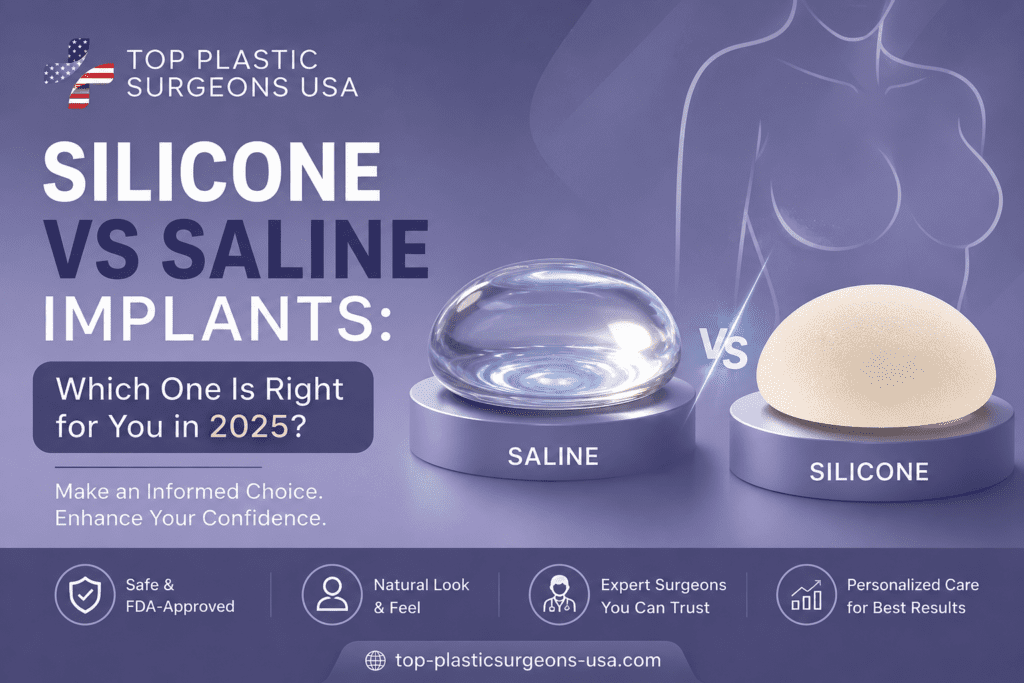
One of the first things your surgeon will ask you if you want to get breast implants is what kind of implant you want: silicone breast implants or saline breast implants? Both of these options have been fixed, are safe, FDA-approved, and are used by many people in the United States. But they’re not the same, and picking the right one can really change how you look, feel, and heal.
There is no one implant that is better for everyone. Silicone feels softer and more natural, but saline is easier to keep an eye on if something goes wrong. Your body type, budget, lifestyle, and how comfortable you are all affect the choice. We will show you everything you need to know so you can talk to your surgeon with confidence.
What Are Silicone and Saline gel Implants?
Both saline and silicone breast implants have a hard outer shell made of silicone rubber. The difference is what they hold inside.
A thick, gel-like material that feels like natural breast tissue is already inside silicone implants. The gel is smooth and moves like real tissue does. Your surgeon can’t change the size once they are put in because they are already filled.
For saline implants, the empty shell is put into the breast pocket first, and then sterile saltwater is added to it once it is in place. This lets the surgeon make small changes to the size during the procedure. One reason many patients feel safe with saline implants is that if they leak, your body naturally absorbs the saltwater.
Both kinds have been safe to use for decades. The FDA has approved silicone implants for women 22 and older, and saline implants for women 18 and older.
Key Differences: Silicone vs Saline Implants
Here is a side-by-side look at how these two implant types compare:
| Feature | Silicone Implants | Saline Implants |
| Feel | Soft, natural, like real tissue | Firmer, more noticeable |
| Appearance | Very natural, especially in thin patients | Can show rippling under the skin |
| Rupture detection | Difficult, requires MRI scan | Easy, implant deflates visibly |
| Starting cost (U.S.) | $5,000 to $8,000 total | $3,500 to $6,000 total |
| Incision size | Slightly larger incision needed | Smaller incision possible |
| Size adjustment | Fixed before surgery | Minor adjustments during surgery |
| FDA approval age | 22 and older | 18 and older |
| Monitoring | Periodic MRI scans recommended | No special monitoring needed |
| Durability | 10 to 20 years on average | 10 to 20 years on average |
Pros and Cons of Silicone Implants
Pros
In the US, silicone implants are the most popular choice, and there are good reasons for this. They are the most like real breast tissue in terms of look and feel. Silicone works better for women with less natural breast tissue because the gel doesn’t show through the skin as much.
Silicone is much less likely to cause rippling, which is when you can see small folds or wrinkles through the skin. This is very important if you are thin or have a small frame.
Cons
The biggest worry about silicone is something called a “silent rupture.” The gel doesn’t spill out if the shell breaks. You might not notice anything at all. This is why the FDA says that after the first three years of having silicone implants, you should get an MRI scan every two to three years. Some women feel better knowing that the gel stays in place. Some people get stressed out when they don’t know right away if something has changed.
Silicone implants also tend to be more expensive at first, and they need a slightly bigger cut because they are already filled.
Pros and Cons of Saline Implants
Pros
There are a few clear benefits to saline implants. The most comforting thing is that you’ll know right away if the shell breaks. The body safely absorbs the saltwater, and the breast will change shape in a way that is easy to see. There is no damage that isn’t obvious, and you don’t need to get MRIs on a regular basis.
They are also usually cheaper, which makes them a good choice for patients who are trying to save money. Surgeons can make a smaller cut because the shell goes in empty and is filled after placement. This may mean that the scar is less visible.
Saline also lets you make small changes during surgery for women who want each breast to be a little bit different sizes.
Cons
Saline implants feel firmer than silicone implants, especially in women who don’t have a lot of natural breast tissue. They are also more likely to show rippling or wrinkling under the skin, especially on the sides or top of the breast.
If you care most about how natural it feels and looks, saline may not be as good as silicone.
Safety and Risks in 2025
Both silicone and saline implants are considered safe by the FDA, and millions of women in the U.S. live comfortably with them. That said, like any surgery, breast augmentation does carry some risks. Here is what to know:
Capsular contracture is one of the most common complications. This is when the natural scar tissue that forms around the implant begins to tighten and harden. It can cause discomfort and change the shape of the breast. It can happen with either implant type.
Rupture is possible with both silicone and saline, though the way you find out about it differs, as described above.
Infection is a risk with any surgical procedure. Your surgeon will take precautions to minimize this risk, and most cases are treatable with antibiotics.
Breast implant illness (BII) is a term used to describe a range of symptoms some women report after getting implants, including fatigue, brain fog, and joint pain. Research into BII is still ongoing, and if you have concerns, it is worth discussing openly with your surgeon.
Breast implant-associated anaplastic large cell lymphoma (BIA-ALCL) is a rare type of cancer that has been linked primarily to textured implants. Most modern implants used today are smooth-surfaced, which significantly reduces this risk. The FDA has been closely monitoring this issue, and your surgeon can walk you through the current guidance.
The most important thing you can do is choose a board-certified plastic surgeon and attend all follow-up appointments.
Who Should Choose Silicone vs Saline?
There is no universal right answer, but here are some general guidelines to help you think it through.
Silicone may be a better fit if you:
- Have very little natural breast tissue.
- Want the most natural look and feel possible.
- Are comfortable with periodic MRI monitoring.
- Have a higher budget.
- Are 22 years or older.
Saline may be a better fit if you:
- Want a lower upfront cost.
- Prefer knowing right away if a rupture occurs.
- Have enough natural breast tissue to soften the feel of the implant.
- Are between 18 and 21 years old.
- Prefer a smaller incision or minimal scarring.
Your surgeon’s opinion matters here too. They will assess your body structure, skin thickness, and natural tissue coverage to help guide you toward the option most likely to give you the results you want.
Latest Trends in 2025
The world of breast implants has changed quite a bit over the past decade, and 2025 brings a few noteworthy shifts.
Cohesive gel implants, often called “gummy bear” implants, have become increasingly popular. These are a type of silicone implant filled with a firmer, form-stable gel that holds its shape even if the shell is cut. They tend to maintain their shape longer and have a lower rupture rate compared to older silicone gel types.
Patient preferences are shifting. More women are opting for smaller, more proportionate results rather than dramatic size changes. The focus has moved toward natural-looking enhancement that fits the body rather than standing out from it.
Surgical precision has improved. Techniques like 3D imaging and simulation software now allow surgeons to show patients a preview of expected results before the procedure. This helps patients make more informed decisions and reduces the chance of disappointment.
Hybrid augmentation, which combines implants with fat transfer, is gaining attention for patients who want subtle volume with an especially natural feel.
Cost Comparison in the U.S.
The total cost of breast augmentation in the United States typically includes the surgeon’s fee, facility charges, anesthesia, and the implants themselves. Here is a general range based on 2025 national averages:
| Cost Component | Silicone Implants | Saline Implants |
| Surgeon’s fee | $3,000 to $5,000 | $2,500 to $4,500 |
| Anesthesia | $1,000 to $1,500 | $1,000 to $1,500 |
| Facility fee | $800 to $1,200 | $800 to $1,200 |
| Total average range | $5,000 to $8,000+ | $3,500 to $6,000+ |
Keep in mind that these are estimates, and your actual cost will depend on:
- The city or state where you have the procedure.
- Your surgeon’s experience and reputation.
- Whether any revision surgery is needed later.
- Pre and post-operative care included in the package.
Breast augmentation is generally not covered by health insurance unless it is part of reconstructive surgery. Many plastic surgery practices offer financing options to make it more accessible.
Frequently Asked Questions
Which implant feels more natural?
Silicone implants generally feel closer to natural breast tissue. The gel inside has a similar softness and movement to real tissue, especially for women with little natural coverage. Saline implants feel firmer and can feel more artificial, particularly in slender women.
Are silicone implants safe in 2025?
Yes. Silicone implants have been used safely for over 50 years and are approved by the FDA for women 22 and older. Modern silicone gel implants are more durable and reliable than earlier generations. The main recommendation is periodic MRI monitoring to check for silent ruptures, usually starting three years after surgery and then every two to three years after that.
How long do breast implants last?
Most implants last 10 to 20 years, though many women keep them longer without issues. Implants are not lifetime devices, and you may need a replacement or revision at some point. Your surgeon can help you understand what to watch for over the years.
What happens if an implant ruptures?
With saline, the deflation is noticeable within days. The saltwater is harmlessly absorbed by the body, and the breast changes shape. You would then schedule a replacement surgery.
With silicone, the gel tends to stay within the shell or surrounding tissue, so you may not notice any change. This is why MRI scans are recommended for silicone implant patients, so any rupture can be detected even without visible symptoms.
Can I switch from saline to silicone later?
Yes. Many women choose to replace saline implants with silicone at some point, whether for a different feel, an updated size, or as part of a revision procedure. This is a separate surgery and involves its own costs and recovery period.
Do implants affect breastfeeding or mammograms?
Most women with implants can breastfeed, though results vary. It depends on the type of surgery, where the implants are placed, and individual anatomy. For mammograms, implants can partially block imaging, so make sure to let your technician know you have implants. Special imaging techniques can be used to get a more complete view.
Conclusion
It all depends on what matters most to you when it comes to choosing between silicone and saline implants. Silicone is usually the better choice if you want something that feels natural and are okay with getting MRIs every now and then. Saline is worth a serious look if you want a lower cost, easier rupture detection, and a scar that is a little smaller.
There are pros and cons to both implants, and neither one is perfect. The most important thing is to talk to a board-certified plastic surgeon who is open and honest with you, listens to your goals, and helps you understand what is realistic for your body.
Top Plastic Surgeons USA helps people find board-certified plastic surgeons who have been practicing for a long time all over the country. Use our directory to find a surgeon near you and set up a consultation if you’re ready to move forward.