


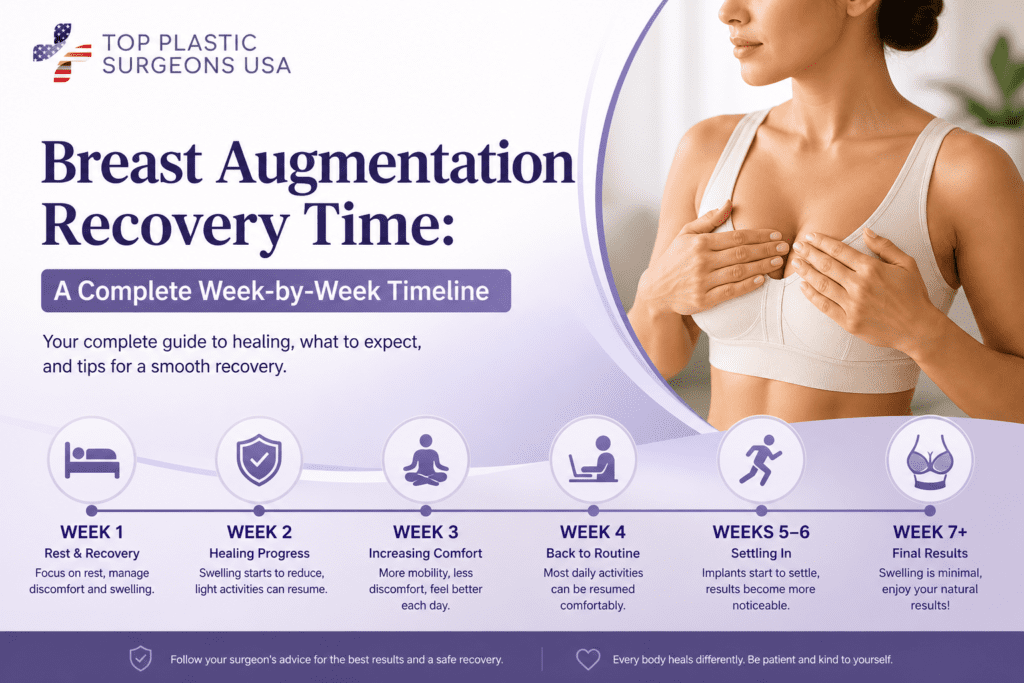
Most people recover from breast augmentation in 4 to 6 weeks. You will feel much better after the first two weeks, and by week six, most daily activities are back to normal. Full healing, including how the implants settle and scars fade, takes about 3 to 6 months.
That said, everyone heals in their own way. Your age, health, implant type, and how well you follow post-surgery care all of these things play a key role. This breast augmentation healing timeline breaks it all down in simple, plain language so you know exactly what to expect and when.
Whether you are just doing your research or you already have a surgery date, keep reading. This timeline will help you plan, feel confident, and heal as smoothly as possible.
What Is Breast Augmentation?
Breast augmentation is a surgery where a doctor places implants inside your breasts to make them larger, rounder, or more balanced. The implants can be placed under or over the chest muscle, depending on what your surgeon recommends for your body type and goals.
People choose this surgery for many reasons: to restore fullness lost after pregnancy or weight loss, to feel more balanced in clothes, or simply to feel more confident in their body.
Is It the Same as a Breast Lift?
No, and this is one of the most common mix-ups. Here is the simple difference between them. They are:
Breast augmentation adds volume using implants. It makes breasts bigger or fuller but does not fix sagging.
A breast lift removes extra skin and moves the nipple higher to give breasts a perfect shape. It does not add size.
Some people get both done at the same time. If you are not sure which one you need, a board-certified plastic surgeon can help you figure it out during a consultation.
Week-by-Week Breast Augmentation Recovery Timeline
This is the part most people come here for breast augmentation surgery. Let’s go through each stage of the recovery process so you know what is coming week by week.
Week 1: The Hardest Part (But It Gets Better Fast)
The first week is the most uncomfortable, but it is also when your body is working the hardest to heal. Most people say it feels like a really sore chest after a tough workout, but much stronger.
What you will feel at initial recovery:
- Tightness and pressure across your chest
- Soreness and a dull, aching feeling
- Swelling and some bruising around the breast area
- Tiredness from the anesthesia and surgery
What healing looks like: Your body is closing the surgical area and starting to form new tissue around the implant. The swelling will be at its worst during days 2 to 4, then slowly start to go down.
Activity level: You will need help getting dressed, reaching for things, and even getting up from bed. Rest is a pain medication way to recover. Keep your upper arms close to your sides and avoid raising them above shoulder height.
What to avoid:
- Lifting anything heavier than a light cup of water
- Sleeping on your stomach or side (sleep on your back with your upper body raised slightly)
- Driving (you cannot drive while on pain medicine or when moving your arms is painful)
- Showering until your surgeon says it is okay, usually after 24 to 48 hours.
Tips to heal faster:
- Take your prescribed medicine on schedule, not just when the pain gets bad
- Sleep with a couple of pillows under your upper back to keep your chest slightly raised
- Have someone at home to help you for at least the first 3 to 5 days
- Wear the surgical bra your doctor gives you. It supports healing and reduces swelling
Week 2: Turning the Corner
By week two, most people notice a real improvement. The sharp soreness starts to fade into more of a dull ache. You will still be tired, but you can start doing a little more around the house.
What you will feel:
- Less pain, though the chest still feels tight
- Swelling is slowly going down
- Some itching around the incision area. This is actually a good sign that healing is happening
- You may notice the implants sit high on the chest; this is completely normal at this stage
What healing looks like: The incision lines are closing, and your body is getting used to the implants. The implants will look and feel a bit stiff or high right now. You do not have to be worried they will soften and settle over the coming weeks.
Activity level: Light walking is encouraged. Short, slow walks around the house or neighborhood help with blood flow and lower the risk of blood clots. Avoid anything that raises your heart rate or puts pressure on your chest.
What to avoid:
- Lifting more than 5 to 10 pounds
- Reaching, stretching, or twisting your upper body
- Underwire bras (stick with the soft surgical bra)
- Any form of exercise beyond light walking
Tips to heal faster:
- Eat foods rich in protein and vitamins to help tissue repair (eggs, meat with less visible fat and fewer calories from fat, vegetables which are rich in fiber).
- Stay hydrated. Your body needs water to heal faster.
- Keep all follow-up appointments with your surgeon.
Weeks 3 and 4: Getting Back to Normal Life
This is when things start to feel much more like your regular routine. Many people go back to work around this time, especially if they have a desk job that does not involve physical labor.
What you will feel:
- Noticeably less soreness.
- Swelling continues to reduce, though it may still come and go.
- The implants may start to feel a little softer and look more natural than before weeks.
- Occasional sharp or shooting sensations in the breast. This is nerves waking back up and is totally normal.
What healing looks like: The incision lines are becoming scar tissue, and the area around the implant is forming a thin layer called the capsule, which is just your body’s natural response to having a foreign object inside. The implants will slowly move into a more natural, lower position on the chest.
Activity level: You can return to light office work, short trips(few small work outside the home), and most daily tasks. You can drive again once you are off pain medicine and can move your arms comfortably. Avoid heavy activity.
What to avoid:
- Heavy lifting (more than 10 to 15 pounds).
- High-impact exercise like running or jumping.
- Any activity that causes bouncing or strain in the chest.
Tips to heal faster:
- Start using scar cream or silicone sheets on your incision lines if your surgeon recommends it
- Avoid sun exposure directly on the incision lines. UV rays can darken scars
- Ask your surgeon about gentle massage techniques to help the implants settle
Weeks 5 and 6: Feeling Like Old Yourself Again
Most people feel really good after six weeks. The discomfort is mostly gone, and daily life is back to normal. Your chest looks much more natural, and the implants have settled quite a bit.
What you will feel:
- Minimal pain or discomfort.
- Swelling is mostly gone, though some minor puffiness can stick around for a few more weeks.
- The breasts feel softer and sit lower and more naturally on the chest.
- More movement and flexibility in the upper body.
What healing looks like: The scar tissue is maturing, and the implants are settling into their final position. The capsule forming around the implant is still thickening but is doing its job properly.
Activity level: With your surgeon’s approval, you can start returning to lower-body exercise like walking on a treadmill, gentle cycling, or light yoga. No upper-body weights or chest exercises yet.
What to avoid:
- Upper-body strength training.
- High-impact cardio like running unless your surgeon says it is okay.
- Underwire bras if the incision area still feels sensitive
Tips to heal faster:
- Keep following your surgeon’s instructions.
- Listen to your body; if something causes discomfort, then suddenly stop.
- Take photos to track your progress; most people are pleasantly surprised by the changes week to week.
Weeks 6 to 8 and Beyond: The Final Augmentation procedure
By week eight, most people have fully returned to their regular lifestyle, including exercise. Your implants will continue to settle and soften over the next several months.
What you will feel:
- Minimal to no pain.
- The breasts feel close to their final look and feel.
- Scars are fading and flattening, though this takes time.
- Energy levels are completely back to normal.
What healing looks like: The capsule around the implant is now stable. The implants have mostly settled into their permanent position. Scars will continue to fade and soften for 12 to 18 months after surgery.
Activity level: Full activity is usually cleared by 6 to 8 weeks for most patients. This includes running, lifting, and chest exercises but get the green light from your surgeon first.
Tips for the lasts a long time:
- Wear a supportive sports bra during high-impact exercise to protect your implants.
- Keep up with annual check-ins with your surgeon.
- Use sunscreen on scar areas even after they have healed.
Factors That Affect How Long Recovery Takes
Here are the main things that can speed up or slow down your healing.
Type of Implant
Silicone implants are softer and tend to feel more natural faster. Saline implants can feel firmer at first. Both types of implant have similar recovery timelines overall.
Where the Implant Is Placed
Implants placed under the chest muscle (called submuscular placement) tend to cause more soreness in the first week or two because the muscle has to stretch to fit the implant. Recovery from over-the-muscle placement is usually a bit quicker but may not look as natural on everyone.
Your Age and General Health
Younger patients with no ongoing health issues tend to heal faster. If you smoke, have diabetes, or have a weakened immune system, healing may take longer and the risk of complications is higher.
Your Lifestyle Before Surgery
People who eat well, exercise regularly, and do not smoke before surgery generally have smoother recoveries. Your body goes into surgery in better shape, so it bounces back faster.
How Closely You Follow Post-Surgery Instructions
This one is entirely in your hands to recover faster. Patients who rest properly, take their medicine, avoid heavy lifting, and go to all their follow-up appointments heal faster and have fewer problems.
Practical Recovery Tips for Better Healing
Here are some real, useful tips that make a real difference during breast augmentation recovery.
Sleep on your back. This is one of the most important things you can do. Sleeping on your side or stomach puts pressure on the implants and can slow healing. Use a wedge pillow or stack regular pillows to keep your upper body at a slight angle.
Move a little, but not a lot. Short, gentle walks starting in week two help blood flow and prevent clots. But do not push yourself. If something hurts, immediately stop.
Eat to heal. Your body is repairing tissue, so it needs good food. Focus on protein (chicken, eggs, fish, beans), vitamin C (oranges, broccoli, berries), and zinc (nuts, whole grains). Avoid salty foods that can increase swelling.
Stay hydrated. Drink at least 8 glasses of water a day. Dehydration slows healing and makes pain feel worse.
Do not rush back to the gym. Many people make the mistake of going back to exercise too early because they feel good. Feeling okay is not the same as being healed. Follow the surgeon consultation schedule.
Wear your surgical bra. It is not the most comfortable thing you have ever worn, but it supports your breasts, reduces swelling, and protects the implants while they settle.
Ask for help. This is not the time to push through on your own. Have someone with you for at least the first few days, especially if you have kids or other responsibilities at home.
Avoid smoking and alcohol. Both slow healing significantly. Smoking reduces blood flow to the healing tissue. Alcohol can react with pain medicine and increase swelling. Stay away from both for at least 4 to 6 weeks after surgery.
When to Call Your Surgeon Right Away
Some discomfort after surgery is completely expected. But certain signs mean something is wrong and you need to call your surgeon immediately. Do not wait to see if it gets better on its own.
Call your surgeon right away if you notice the following symptoms. Such as:
- Fever above 101°F (38.3°C).
- One breast that is noticeably more swollen, red, or warm than the other.
- Sudden increase in pain that is getting worse, not better.
- Discharge from the incision that is thick, cloudy, or smells bad.
- The skin around the incision looks very red and is spreading outward.
- Shortness of breath, chest pain, or pain in your legs (these can be signs of a blood clot).
- You feel like something has “popped” or changed suddenly inside the breast
These signs are rare, but catching them early makes a big difference in outcomes. When you are in doubt, call your surgeon’s office. That is what they are there for.
Breast Augmentation vs. Breast Lift: What Is the Difference?
This is one of the most searched questions in plastic surgery, and it causes a lot of confusion. Here is a clear, side-by-side breakdown of Breast Augmentation vs Breast Lift.
| On the basis of | Breast Augmentation | Breast Lift |
| What it does | Adds volume and size using implants | Removes extra skin and raises the breast position |
| Who it is for | People who want larger or fuller breasts | People whose breasts sag or have lost their shape |
| Change size? | Yes | No (unless combined with augmentation) |
| Fixes position? | No | Yes |
| Implants used? | Yes | No (unless combined with augmentation) |
| Recovery time | 4 to 6 weeks | 4 to 6 weeks |
| Scars | Small, near the fold or around the nipple | More visible, around the nipple and sometimes below |
| Can they be combined? | Yes, many patients choose both | Yes |
The best way to figure out which procedure is right for you is to consult with a board-certified plastic surgeon. They can look at your current shape, skin quality, and goals and recommend the best approach.
Frequently Asked Questions About Breast Augmentation Recovery
How Long Does Breast Implant Recovery Take?
Most people feel back to normal within 4 to 6 weeks. However, full healing, including the implants settling and scars fading, takes 3 to 6 months. Some changes in how the breast looks and feels can continue for up to a year after surgery.
When can I go back to work after breast augmentation surgery?
If you have a desk job or work from home, many people return to work between days 5 and 14. If your job involves physical labor, lifting, or a lot of upper-body movement, you will need to wait at least 4 to 6 weeks and get clearance from your surgeon before going back.
When can I exercise again after breast augmentation?
Light walking can start in week two. Lower-body exercises like cycling or light yoga may be okay around weeks 4 to 6 with your surgeon’s approval. Full return to upper-body workouts and high-impact exercise is usually cleared around week 6 to 8, but this varies by person and surgeon.
How long does swelling last after breast augmentation?
Most of the obvious swelling goes down within 3 to 4 weeks. However, minor, subtle swelling can stick around for 3 to 6 months. Many people notice their results changing and improving gradually during this time as the swelling fully resolves and the implants settle.
When will my implants stop feeling so high and stiff?
This is very common in the first 2 to 4 weeks. The implants start high on the chest because the skin and muscle are tight. Over 2 to 3 months, they gradually soften and drop into a more natural position. This process is called “dropping and fluffing” and is a completely normal part of healing.
Can I sleep on my side after breast augmentation?
Most surgeons say to sleep on your back for at least the first 4 to 6 weeks. Sleeping on your side can put pressure on the implants and cause discomfort or affect their final position. After 6 weeks, ask your surgeon when it is safe to switch positions.
Is it normal to feel depressed or emotional after surgery?
Yes, this is more common than people talk about. The combination of anesthesia, pain medicine, reduced activity, and the stress of recovery can make some people feel low, anxious, or teary during the first one to two weeks. This usually passes on its own. If it persists or gets severe, talk to your doctor.
How do I know if my implant has moved or shifted?
Look for one breast that looks very different from the other in terms of shape, height, or position. Some difference between the two sides is normal in early healing. If the difference is significant, sudden, or comes with pain, call your surgeon.
Conclusion
Breast augmentation recovery takes time, but for most people it goes smoothly when they know what to expect and follow their surgeon’s guidance. The first week is the hardest. After that, things improve quickly.
Remember: there is no shortcut to healing. Rest, eat well, follow your care instructions, and go to your follow-up appointments. Within 6 to 8 weeks, most people are back to their regular lives, feeling great in their results.
If you are thinking about breast augmentation and want to know if it is the right option for you, the best first step is a consultation with a board-certified plastic surgeon. They can look at your individual anatomy, health history, and goals and create a plan that makes sense for your body.